
For a big part of my life I believed hard work = success. And also, that success = hard work. I bought into the belief that if I just worked hard enough (preferably to burnout) I would be successful – and that this was the only way to succeed.
Boy, was I wrong.
I’m not quite sure when I started to doubt this. Maybe it was already in college when my best friend regularly skipped lectures, and still did better than me. Maybe it was when I first started making passive income and realized that you could actually make money without even working. Or when I had my best month ever while on vacation. Either way, once the doubt was there, there was no going back.
Now, it’s not been a straight line. I still struggle with it, despite knowing intellectually that it’s true. But when in doubt, it feels better to just put in those extra hours… And if I’m not exhausted when I go on vacation, did I even really need (deserve) that vacation?
The truth is, how much you make or how succesful you are is not at all related to how much time you put in. Sure, you need to put something in to get something out – but TIME is not the deciding factor. Exhaustion isn’t, either.
We Have Been Lied To
Do you know someone who works really, really hard? Maybe they’re an entrepreneur, a CEO, a doctor… or maybe they’re a cleaner, a nurse, a care taker.
It’s easy to believe that hard work equals success and money when we think about that first group of people – but we often forget that there are other groups of people who work just as much, or more, that make far less money. If hard work and time spent equalled lots of money, then it would be SO easy – just work more, and everything will be alright.
Oh how I wish it was that easy.
Working More Is the Easy Way Out
There’s a simple reason why when in doubt, we like to work more: it’s the easy way out. Working more might not be the best, most optimal, solution – but it usually gets you some results, and if nothing else, it’s a great way to keep anxiety at bay.
The truth is, working more is the easy way out. Working more will – in the short term – often make you more money. If you get a second job, put in more hours, start a sidehustle, spend double the amount of time to get your blog up and running – this usually means a bit more money.
For now.
And while it might make you 10% more – or even 2x more – it’s not going to make you 10x more. That’s just not how it works.
The better way to do it? Optimize your time. Focus on what gets results, and do more of that – and less of the other stuff.
This sounds easy, but we all know it’s not. If it was, we would all be doing it this way, instead of just working more.
Doing Less Is Scary
Focusing and doing less is scary – because doing less means saying no to things. If we’re doing “everything”, we know (or so we believe) we’re not missing anything. But in reality, we’re not just spending more time than we have to on work, we’re also spreading ourselves thin, so we often end up not doing anything really well.
But to do less, we need to start saying no to things. And they need to be the right things. Which means we need to know what we’re doing. If we aren’t sure what is truly going to move the needle, we won’t know what to focus on and what not, and we might end up saying no to the wrong things.
So instead, we just keep doing everything – because it’s just time, it’s not like it’s running out, right?!
The truth? Life is scary. Running a business is scary. I ride horses every day, that is also scary. Most things that are worth anything are. If we still want to do these things, we need to get comfortable with being uncomfortable. We need to learn how to manage the fear and do it anyway.
And we need to learn to trust ourselves. Instead of hoping that the almighty Google will reward you with a good algorithm update that will magically turn everything around – trust YOU and that YOU know what you are doing. You know what works for your business. You know what works for you. Check the analytics, listen to your intuition. There is always somewhere you can focus in more and something you can let go off.
The Science of Doing Less
Getting the same results, or better, with less input isn’t something new. It’s a well researched phenomena, and several “laws” have been formulated around it.
So don’t take my word for it – read on to see what others have had to say about it.
Parkinson’s Law: how work expands to fill the time available
This “law” started as a satirical observation by British historian Cyril Northcote Parkinson in a 1955 article in The Economist. It states that “Work expands to fill the time available for its completion.”.
Satire or not, any procrastinator (hello, I’m here) who has ever left a project until the very last minute knows the truth of this law all too well. If you only have a few hours to complete a project, it will get done, and it will likely be good enough. If you had a few weeks to get it done, you would also get it done – and the results might be slightly better, but not enough to defend all that extra time spent.
This is true both on the project scale and for our work in general. If you give yourself 40 hours each week to complete your work, you bet it’s going to take 40 hours. But give yourself 30 hours, and you will get so much done in those 30 hours. Will all tasks get done? Maybe not. But will the most important tasks get done? Most likely.
To put this law to work, start setting tight deadlines for yourself. Don’t give yourself more time than you really need to complete your tasks, and instead add some buffer in your work days. It’s OK if you need to spend a few more minutes on the task than what you assigned it – the point is not to deliver something that is not done, it’s to push yourself to be efficient.
The 80/20 Principle (Pareto’s Law)
Pareto’s Law states that 80% of results come from 20% of efforts. This principle has been extensively researched, and so far I’ve never seen any result to disprove it. Go to any company and see where they make their money – I bet you they’re making 80% of their revenue from 20% of their products, and/or 20% of their customers.
And your business is no different! 20% of what you do daily, weekly, monthly is making you 80% of your revenue. If you’re a blogger, it’s likely 80% of your income comes from 20% of your blog posts. If you make TikTok reels, I bet you 80% of the revenue comes from 20% of your reels.
What you want to do is do the analysis, find the 20% of posts, reels, brand deals that make you 80% of your income – and see what they have in common. Are they on a specific topic? Posted a certain day? Featuring a special ingredient?
And what about those other 80% – what sets it apart from the top 20%?
When you know this, you can focus on creating content you know will resonate with your audience. And skip the rest!
So now instead of focusing 20% of your time on that content… you’re focusing 100% (in a perfect world). What do you think that will do to your revenue?
This is why I always do roundups on topics like cheesy casseroles, dump-and-go dinners and slow cooker recipes – and not vegan recipes, side salads or healthy weeknight dinners. Those topics are all great – but they’re not what MY audience wants from ME on MY top platforms.
And the best part? Once you’ve focused in on that 20% – you can do it again. And you can keep doing it, focusing in more and more every so often until you’re only doing what really, truly, moves the needle for you.
The Law of Diminishing Returns
This law is related to both Parkinson’s Law and the Pareto Principle – basically, it states that after a certain point, more effort produces less reward. Yes, you guessed it, you will get 80% of the way there in 20% of the time – and that extra time you spent on it? Did not add all that much value in the end.
This does not mean that extra time spent will not make it slightly better – just that at a certain point it will not be worth the extra time and effort. At some point you just need to hit publish, and call it a day.
Have I published a post I later had to go in and edit because I found a spelling mistake or forgot to add a tip? Sure. Did it matter in the end? No.
The great thing about using these three principles together is that when you set yourself a shorter time to get it done – you will also have less time to tweak and do those “extra but not really necessary” things. Attention to detail is great, but as someone who has spent a great many hours looking for typos in 100-page presentations (yes, this is why management consultants work such long hours), I know that even here, the 80/20 rule applies.
Case Study: How Doing Less Grew My Income
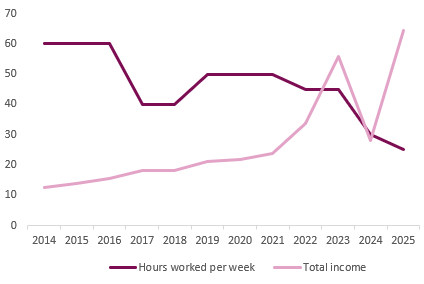
This isn’t just theory or nice ideas – I’ve lived this, and keep living it. Over the past 10 years my income has drastically improved, all while my hours worked keep going down.
2014-2016: Burnt out Consultant
At this time, I worked as a management consultant, making what I thought was a good salary – and working all hours. I traveled a lot, which was sometimes very fun, but also added stress and took time away from the rest of my life. I often worked 60 hours per week – or more – and ended up making around $15 per hour.
I ended up on sick leave in early 2017 after working myself far too hard, and realized this was not the life I wanted after all.
2017-2018: Still Burnt out, more reasonable hours
I switched to a different job that was less exciting, less cool, and much better hours. I also actually made a bit more money! Slowing down was just what I needed and it gave me time to think about what I wanted to do with my life, which led to starting my first food blog in 2018.
2019-2021: Being My Own Boss
In late 2018 I was laid off (together with almost everyone else at the company), and for me this was a blessing in disguise. I got a few months’ extra salary and could spend those months working on my brand new blog, and then set out to do freelance consulting in my own company. I was a bit disappointed in how the blog was doing, but I made OK money consulting so anything extra was a bonus – but I really wanted to make this my full time job!
Working on the blog alongside my 4-day-a-week consulting gig did mean putting in more hours, but I was happy to do it because now I was working on my own thing.
2021-2023: Slowly, blogging is starting to work out
I kept consulting and building the blog and my income kept growing. I managed to renegotiate my consulting terms so I actually worked less (3 days instead of 4) while making more money. Now that’s my type of deal!
2023 was a great year for the blog and it made me decide now was the time to move to full-time blogging.
2024: Finally full-time blogging
This year my income took a dip as I quit consulting and spent 100% of my time on the blog. This meant I could work less and still get all the things done, and I started to focus in on more of the right things and got better at ignoring the rest. It was a scary year that started with very low income (thank you HCU!), but it ended well and I had survived my first year fully on my own.
2025: More focus, more money, more life
This year income really took off and I surpassed my 2024 income already in April. I also got another horse, decided I wanted to work fewer hours, and started focusing even more on what actually moved the needle. I also started planning for the next step in my journey…
As you can see it has not been an entirely straight line – but the trend has been clear. With this new pivot in my business my income for 2026 might end up lower than 2025. And that’s OK! The point is that time worked is not correlated to how much money you make, and you can absolutely make good money while working just 20 hours a week. Or less – at least that’s my plan for the near future.
How to Actually Work Less NOW
To get started using these principles, here’s what to do:
1. Do the analysis
Start by doing a 80/20 analysis of the results you’re getting today. Where is 80% of your revenue coming from? What traffic sources, what type of content? What type of audience? What platforms? Now set a plan to do more of that, and skip the rest.
2. Decide how much you want to work
Since we now know tasks will fill the time you give them, you need to know how many hours a week you’re aiming for. Depending on your personality, you can start slow with just a few hours less than today – or go all in straight away and cut it in half. Or maybe you want to work the same amount, but get more valuable work done in that time. Either way, know your number, so you know what you have to work with.
3. Set Tight Deadlines
Set tight deadlines for your tasks, and don’t overschedule your days. If you’re not sure how much time to set for a task, assign it half the time you think it will take and go from there.
4. Don’t Overschedule your days
The point of setting tight deadlines is NOT to stress you out or to have you leave everything half-finihsed. So make sure to include some buffer time in your days – to start you might need as much as 50% buffer to get things right. This means if you want to work 6 hours per day, you will plan tasks you believe will take you 4 hours, so you have some extra time if you need it.
But don’t spend that time unless you need to! If you’re done early, treat yourself to something you really enjoy, so you are motivated to get everything done quickly. For me it’s going to the barn while it’s still light out (hello November), but for you it might be reading a book on the couch or picking your kids up early.
Next week, reduce the buffer time if you didn’t need it, but always keep a bit of buffer so you know you can get everything done. Better to be done 30 minutes earlier than planned, than rush to your next thing!
5. remember that done is better than perfect
Good enough is your new done – when you’re kinda there, hit publish. It’s good enough. Find something wrong? Just go in and edit later.
6. Rinse & Repeat
Regularly go back to step 1 and do the 80/20 analysis again.
Recommended Reading
If you want to learn more about the science behind working less and achieving more and hear what others have to say on the topic, these are some of my favorite resources:
- Slow Productivity by Cal Newport
- 10x Is Easier Than 2x by Dan Sullivan and Dr. Benjamin Hardy
Work Less, Achieve More
Working smarter is not about doing the bare minimum and magically making money without putting in any effort, it’s about doing what matters most, and removing all “busy-tasks”.
This is what The Work Less Project is all about — helping creators and entrepreneurs achieve more by focusing on what truly moves the needle.
Do you want to learn more? Subscribe to my newsletter and get first dibs on everything new – articles, courses, and more.
Now I’d love to hear from you! Let me know in the comments, just based on your intuition, what would your business look like if you only focused on what really matters? What content would you create, what tasks would you stop doing?
And with that, I’m considering this “good enough”, so if you find any typos – please do let me know 😉